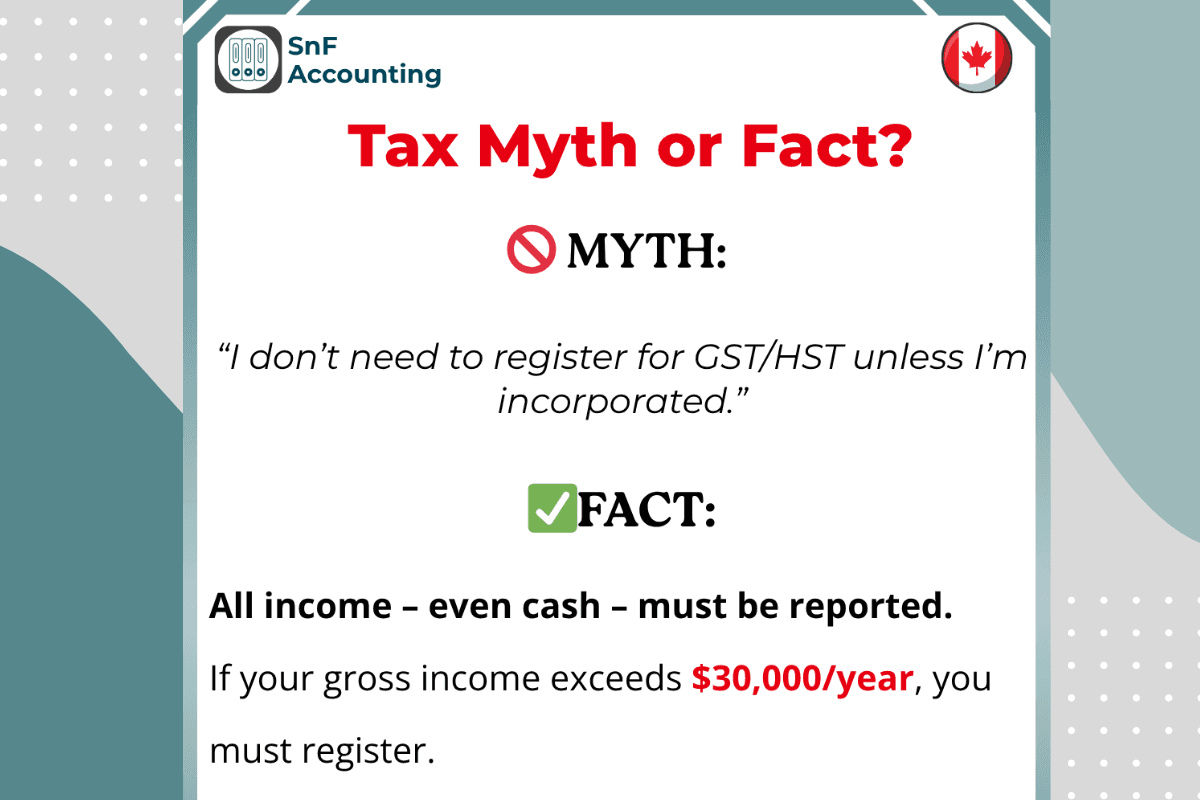
You must register for GST/HST once your business passes $30,000 in gross taxable revenue, measured over four consecutive calendar quarters or within a single quarter. The rule is based on revenue, not business structure: sole proprietors, side hustles and corporations are treated the same. Below $30,000, registration is optional but often pays for itself through input tax credits.
Is GST/HST registration only for incorporated businesses?
That myth costs people real money every year. The fact: incorporation has nothing to do with it. The CRA looks at one thing, your total taxable revenue. A freelance designer invoicing $35,000 a year as a sole proprietor must register. A corporation with $12,000 in sales does not have to (though it can). Past the threshold, you are required to register for a GST/HST account, charge tax and file returns.
One exception runs the other way: self-employed taxi and commercial ride-share drivers (Uber, Lyft) must register from their first dollar of fares; the threshold does not apply to them.
How does the $30,000 small-supplier rule actually work?
This is where most people get it wrong. The test is not "$30,000 in a calendar year." The CRA measures your worldwide taxable revenue over calendar quarters (January to March, April to June, and so on). You stop being a small supplier in one of two ways, with different timing rules for each.
You cross $30,000 within a single calendar quarter
If one strong quarter pushes you over $30,000 on its own, you lose small-supplier status immediately. Your effective date is the day of the sale that put you over the line, you must charge GST/HST on that very sale, and you have 29 days to apply for registration. A Shopify seller doing $14,000 in July, $11,000 in August and $9,000 by mid-September must charge GST/HST on the September order that crosses $30,000, before the registration paperwork is even filed.
You cross $30,000 over four consecutive calendar quarters
If your revenue creeps past $30,000 gradually over four consecutive quarters, you get a short grace period: you remain a small supplier until the end of the month following the quarter in which you exceeded the threshold. Your effective date is your first taxable sale after that, with 29 days to register. Example: your rolling four-quarter total passes $30,000 in February. You keep small-supplier status until April 30, and your first sale in May triggers registration. The CRA publishes worked examples of both scenarios on its when to register page.
What counts toward the $30,000 threshold?
Almost everything. It includes worldwide revenue from taxable supplies, before expenses:
- Product sales on your own website, Amazon, Etsy or at markets
- Freelance, consulting and other service income
- Digital products, subscriptions and content income
- Zero-rated sales such as exports (taxed at 0%, but they still count)
- Revenue of associated businesses, such as a second corporation you control
It is gross revenue, not profit. A reseller who turns over $40,000 with a $6,000 margin is over the threshold. Revenue from financial services and from selling capital property is excluded. A Canadian seller shipping mostly to US customers can still be required to register even though exports are zero-rated.
Should you register voluntarily before you hit $30,000?
Often, yes. Three practical advantages:
- Input tax credits (ITCs). Registrants recover the GST/HST paid on business expenses. An Ontario e-commerce startup spending $8,000 on inventory, software and packaging pays about $1,040 in HST. Unregistered, that money is gone. Registered, it comes back as ITCs, often as a refund cheque in a low-sales startup year.
- Credibility. Business clients expect a GST/HST number on invoices. Its absence signals that you bill under $30,000.
- No threshold-watching. You never risk charging tax one sale too late.
The trade-offs: you must charge GST/HST from your effective date, file returns even when nothing is owing, and generally stay registered for at least one year. If your customers are consumers rather than businesses, adding 13% to your Ontario prices is a real competitive consideration.
How do you register for GST/HST?
Registration is free and takes minutes. You receive a nine-digit business number (BN) if you do not already have one, plus an RT program account for GST/HST. Three routes:
- Online through the CRA's Business Registration Online service, the fastest option
- By phone at 1-800-959-5525
- By mail or fax using Form RC1, Request for a Business Number
If you crossed the threshold, your effective date is set by the rules above, not by when you fill in the form. Register late and you still owe the tax you should have collected from that date forward, whether or not you charged it.
How often do you have to file GST/HST returns?
The CRA assigns a reporting period based on annual taxable supplies; you can elect to file more often:
| Annual taxable supplies | Assigned filing frequency | Optional elections |
|---|---|---|
| $1,500,000 or less | Annual | Quarterly or monthly |
| Over $1,500,000 up to $6,000,000 | Quarterly | Monthly |
| Over $6,000,000 | Monthly | None |
Most small businesses start as annual filers, though filing more often can help e-commerce sellers who sit in refund positions because of zero-rated exports.
What is the quick method, and can it save you money?
The quick method is a simplified way to calculate what you remit. You still charge customers the full GST/HST rate (13% in Ontario), but instead of tracking ITCs on every expense, you remit a flat percentage of tax-included sales. For an Ontario service business selling in Ontario, that rate is 8.8%, plus a 1% credit on the first $30,000 of tax-included sales each fiscal year.
Worked example: an Ontario consultant bills $100,000 plus $13,000 HST, so $113,000 tax-included. Quick method remittance is 8.8% of $113,000, or $9,944, minus the $300 credit: $9,644 total. Under the regular method with only $1,000 of ITCs, they would remit $12,000, so the quick method saves roughly $2,350 with less bookkeeping. The catch: you give up ITCs on most operating expenses (capital purchases like equipment are still claimable), so it suits low-expense service businesses far better than inventory-heavy retailers.
Eligibility: annual worldwide taxable supplies, including GST/HST and those of associates, must not exceed $400,000, and certain businesses (accountants, bookkeepers, lawyers, financial consultants, actuaries) cannot use it. Run the numbers both ways before electing.
Does GST/HST registration cover provincial sales taxes too?
No, and this trips up a lot of e-commerce sellers. Your GST/HST account covers the 5% GST and the harmonized rates: 13% in Ontario, 14% in Nova Scotia (reduced from 15% on April 1, 2025) and 15% in New Brunswick, Newfoundland and Labrador, and Prince Edward Island. For goods, you charge the rate of the province you ship to, not the one you ship from.
Four provinces run separate sales taxes with their own registration systems: British Columbia (7% PST), Saskatchewan (6% PST), Manitoba (7% RST) and Quebec (9.975% QST, administered by Revenu Québec). Each sets its own rules and thresholds for out-of-province sellers, so shipping meaningful volume into BC or Quebec may require provincial accounts on top of your GST/HST account. Good record keeping by province of delivery is what makes this manageable.
What about Amazon, Etsy and Shopify sellers?
Since July 1, 2021, marketplace operators such as Amazon, Etsy and eBay are treated as the deemed supplier for sales by non-registered sellers, and the platform collects and remits the tax on those sales. Some sellers conclude they never need to register. Not quite.
Your marketplace sales still count toward your own $30,000 threshold, so once you cross it, registration is mandatory. After you add your GST/HST number in Seller Central, Amazon collects the tax and passes it to you in disbursements; you remit it on your return and claim ITCs on FBA fees, referral fees and other inputs. A standalone Shopify store is not a marketplace: nobody collects for you, so you configure the tax settings and remit everything yourself. See our guide to GST/HST for Shopify and Amazon sellers; our e-commerce accounting service handles registration, filings and marketplace reconciliation for one fixed fee.
Frequently Asked Questions
Do I need to register for GST/HST if I earn under $30,000?
No, registration is optional below $30,000 in worldwide taxable revenue. You are a small supplier and cannot charge GST/HST unless you register. Many businesses register voluntarily anyway to recover tax paid on expenses through input tax credits, which frequently produces refunds in startup years. The exception is taxi and commercial ride-share drivers, who must register regardless of income. Voluntary registrants should expect to stay registered for at least a year and file returns even when sales are minimal.
Is the $30,000 threshold based on profit or revenue?
Gross revenue, before any expenses. A dropshipper with $45,000 in sales and $38,000 in costs is well past the threshold even though the profit is only $7,000. The calculation includes worldwide taxable supplies, zero-rated sales such as exports, and revenue of associated businesses, but excludes financial services and sales of capital property. Because it is measured over calendar quarters rather than your fiscal year, check your rolling four-quarter total regularly, not just at year-end.
What happens if I passed $30,000 and never registered?
The CRA can register you retroactively and assess the tax you should have collected, plus interest and potentially penalties. You owe that tax whether or not you charged it, so it comes straight out of your margin. Registering promptly and filing the outstanding returns is almost always cheaper than waiting for the CRA to find it. A CPA can often reduce the damage by claiming the ITCs you were entitled to in those same periods.
Amazon already collects tax on my sales. Do I still need to register?
If you are a Canadian seller and your worldwide taxable sales pass $30,000, yes. The marketplace rules make Amazon responsible for collecting on behalf of non-registered sellers, but they do not erase your registration obligation once you cross the threshold. After registering, you add your GST/HST number to Seller Central, receive the collected tax in your disbursements and remit it on your return. Registration also lets you claim input tax credits on Amazon fees, inventory and shipping, which unregistered sellers lose.
Can I cancel my GST/HST registration if sales drop below $30,000?
Generally yes, once you qualify as a small supplier again and have been registered for at least one year. Cancelling has consequences: you stop claiming input tax credits, and you may have to account for tax on assets you keep in the business when you deregister. If the dip is temporary, staying registered is usually simpler than cancelling and re-registering later. Review the decision with an accountant first, because the clawback on remaining assets can be a surprise.
Not sure whether to register now, wait, or elect the quick method? Book a free 30-minute consultation with SNF Accounting. We are a CPA-led firm serving all of Canada, with fixed pricing from $199 per month covering bookkeeping, GST/HST filings and year-end returns.