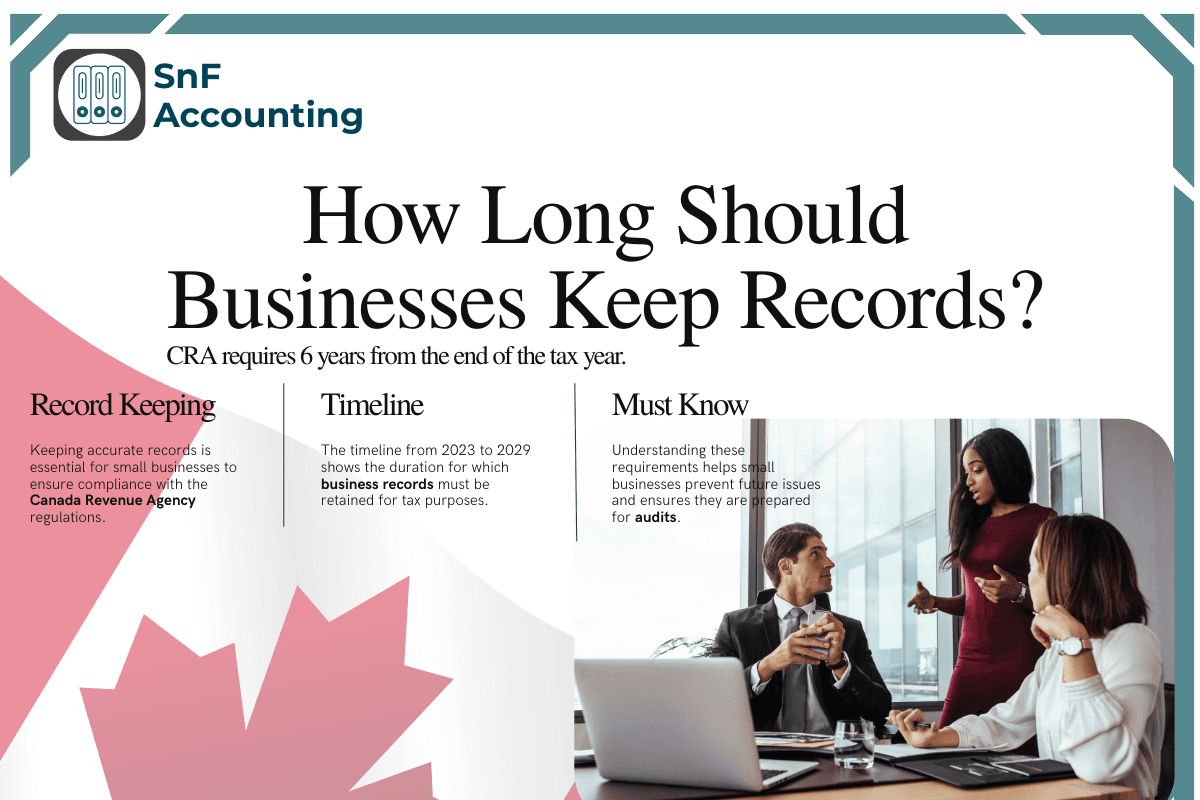
The Canada Revenue Agency requires small business owners to keep their business records for at least six years from the end of the last tax year they relate to. That covers invoices, receipts, bank statements, payroll files and vehicle logbooks, whether stored on paper or digitally. If you cannot produce records during a review, the CRA can deny your deductions outright or assess tax based on its own estimate of your income.
How long do you have to keep business records in Canada?
The general rule, set out on the CRA's Keeping records pages, is six years from the end of the last tax year the records relate to. The clock starts at the end of the tax year, not on the date printed on the document. For a sole proprietor, the tax year is the calendar year, so the receipts behind your 2025 return must be kept until December 31, 2031. For a corporation, the tax year is its fiscal period: a company with a July 31 year-end counts six years from each July 31.
Pay attention to the phrase "last tax year they relate to." Some documents relate to more than one year. The purchase invoice for a delivery van you depreciate through capital cost allowance relates to every year you claim CCA on it, so its six-year clock only starts after the last year the van appears in your return. The practical takeaway: keep asset purchase documents for the life of the asset plus six years.
Several situations change the standard period:
| Situation | How long to keep records |
|---|---|
| You filed your return on time | Six years from the end of the tax year the records relate to |
| You filed a return late | Six years from the date you filed that return |
| You filed an objection or appeal | Until it is resolved and the time to file any further appeal has expired, or the six-year period ends, whichever is later |
| Your corporation is dissolved | Two years after the date of dissolution |
| The CRA requires a longer period | As directed; the CRA notifies you in person or by registered mail |
Want to shred earlier than that? You need the CRA's written permission first, requested with Form T137. Destroying records before the retention period ends without permission can lead to prosecution. The CRA explains the details on its page about where to keep your records and for how long.
What records does the CRA expect you to keep?
Everything that supports the income you reported and the expenses, deductions and credits you claimed. In practice, that breaks down into five buckets.
Income records
Invoices you issued, sales summaries, point-of-sale reports, payment processor and marketplace payout statements, contracts and deposit slips. If you sell through Shopify or Amazon, download the payout and fee reports monthly; do not assume the platform will keep them available forever.
Expense records
Supplier invoices and itemized receipts, not just card statements. A statement proves you paid someone; it does not prove what you bought, whether it was a business expense, or how much GST/HST you paid, which matters if you claim input tax credits. If you are unsure what qualifies in the first place, read our guide on what counts as a business expense and what doesn't.
Banking records
Business bank and credit card statements, cancelled cheques, deposit slips and loan agreements. A separate business account makes every one of these documents cleaner and an audit dramatically shorter.
Payroll records
Hours worked, pay rates, T4 information, CPP and EI remittance records, and contracts with employees and subcontractors. These follow the same six-year retention rule.
Vehicle logbooks
For each business trip: the date, destination, purpose and kilometres driven, plus odometer readings at the start and end of the year. The CRA allows a simplified approach: keep a full logbook for one complete base year, then a three-month sample logbook in later years, as long as business use stays within 10 percentage points of the base-year result. If vehicles are the business itself, as with a rental fleet or Turo operation, per-vehicle files and logbooks carry even more weight; that is a core part of our car rental accounting service.
Are digital records acceptable to the CRA?
Yes, and for most owners digital is the smarter default. But the CRA attaches conditions, set out in Information Circular IC05-1, Electronic Record Keeping:
- Electronically readable and usable. Records must be kept in a format the CRA's auditors can access and process, not a locked or proprietary format nobody can open.
- Born digital stays digital. Documents created, transmitted or received electronically must be retained in electronically readable form. Printing an e-invoice does not replace the electronic record.
- Scans of paper are acceptable. Imaged copies of paper documents qualify if they are produced following proper imaging practices and the images are legible, complete, true copies.
- Location matters. Records must be kept at your place of business or residence in Canada unless the CRA gives you written permission to keep them elsewhere. Records sitting on servers outside Canada that you merely access from Canada are not considered records kept in Canada, so check where your software provider stores data or ask your tax services office for permission in writing.
One more point owners miss: the retention obligation is yours, not your software vendor's. If you cancel a subscription, you still must be able to produce six years of records, so export a year-end archive you control.
What happens if you can't produce records?
Three things, and they compound.
Denied deductions. The CRA does not have to accept an expense you cannot support. Say an auditor reviews your 2024 return and disallows $18,000 of undocumented vehicle, supply and subcontractor costs. At a 30 per cent combined tax rate, that is roughly $5,400 of extra tax, plus arrears interest compounding daily from the original balance-due date. GST/HST registrants lose the matching input tax credits too.
Arbitrary assessments. Under subsection 152(7) of the Income Tax Act, the CRA is not bound by your return. Without records, it can estimate your income using bank deposits, industry benchmarks or a net worth analysis, and the burden falls on you to prove the estimate wrong, which is very hard to do without the records you failed to keep. Where the CRA believes income was knowingly understated, gross negligence penalties of 50 per cent of the understated tax can be added.
Prosecution risk. Failing to keep adequate books and records is itself an offence, and destroying records early without CRA permission can be prosecuted. Sloppy books rarely get that far, but they invite deeper, longer audits. Most of the damage starts with everyday errors, and we cover the most frequent ones in avoid these common bookkeeping mistakes.
What does a practical cloud record-keeping setup look like?
You do not need a filing cabinet; you need a routine. Here is the setup we implement for clients:
- Cloud accounting software with bank feeds. Every business account and credit card feeds in automatically, so nothing is invisible.
- Receipt capture on your phone. Photograph every receipt the day you get it and attach it to the matching transaction. Thermal paper fades within months; the scan becomes your permanent record.
- A simple folder structure by year. One cloud drive folder per tax year for contracts, lease agreements, bank statements, government correspondence and year-end reports.
- Monthly reconciliation. Match the books to the bank every month. A transaction you cannot explain 30 days later is a transaction you will never explain in year six.
- Marketplace and platform exports. Shopify, Amazon and payment processors change their reporting tools and lookback windows, so download monthly payout, fee and sales tax reports. This is where e-commerce sellers most often get caught short.
- A year-end archive you own. After filing, export the general ledger, statements and receipt images into that year's folder, then leave it untouched for six years.
Set up once, this runs on about an hour a month. If you would rather hand the whole routine to a CPA firm, our fixed-fee plans start at $199 per month and include the bookkeeping, the software and the audit-ready records.
Frequently Asked Questions
How long does the CRA require small businesses to keep records?
Six years from the end of the last tax year the records relate to. For a sole proprietor, 2025 records must be kept until the end of 2031. If you file a return late, the six years run from the date you actually filed it. The CRA can also require a longer period, and it will notify you in person or by registered mail if it does. A dissolved corporation must keep its records for two years after the date of dissolution.
Are bank and credit card statements enough to satisfy the CRA?
No. Statements prove that money left your account, not what you purchased or why it was a business expense. They also do not show the GST/HST you paid or the supplier's details, which you need to support input tax credit claims. Auditors routinely deny expenses supported only by a statement line. Keep the itemized receipt or supplier invoice and attach it to the transaction in your accounting software so the two are stored together.
Can I store all my business records in the cloud?
Yes, provided the records stay legible, accessible and in an electronically readable format the CRA can work with, and provided they are kept in Canada. Records stored on servers outside Canada that you simply access from Canada are not considered kept in Canada; you need the CRA's written permission for that arrangement. Confirm your provider's data location, keep your own backup export, and remember the obligation survives any software subscription you cancel.
Can I throw away paper receipts after scanning them?
Generally yes. The CRA accepts imaged documents when they are complete, legible, true copies produced following proper imaging practices, as described in Information Circular IC05-1. Scan receipts promptly, since thermal paper fades long before the six-year retention period ends. Many owners still keep paper originals of high-value documents such as leases, purchase agreements and government correspondence, which is sensible even though a compliant scan is acceptable for routine receipts.
What if the CRA asks for receipts I no longer have?
Start reconstructing. Suppliers can reissue invoices, banks can provide historical statements, and contracts, emails and calendars can corroborate that an expense was real and business-related. The CRA may accept alternative evidence, but it is under no obligation to, and undocumented claims are usually denied with interest added. Respond by the deadline in the letter, and get a CPA involved before you reply so the file you submit is complete and consistent.
Not sure your records would survive a CRA review? Book a free 30-minute consultation with SNF Accounting. We will look at what you have, flag the gaps, and if you want it handled for you, our fixed pricing starts at $199 per month for CPA-led bookkeeping that keeps you audit-ready year-round.