
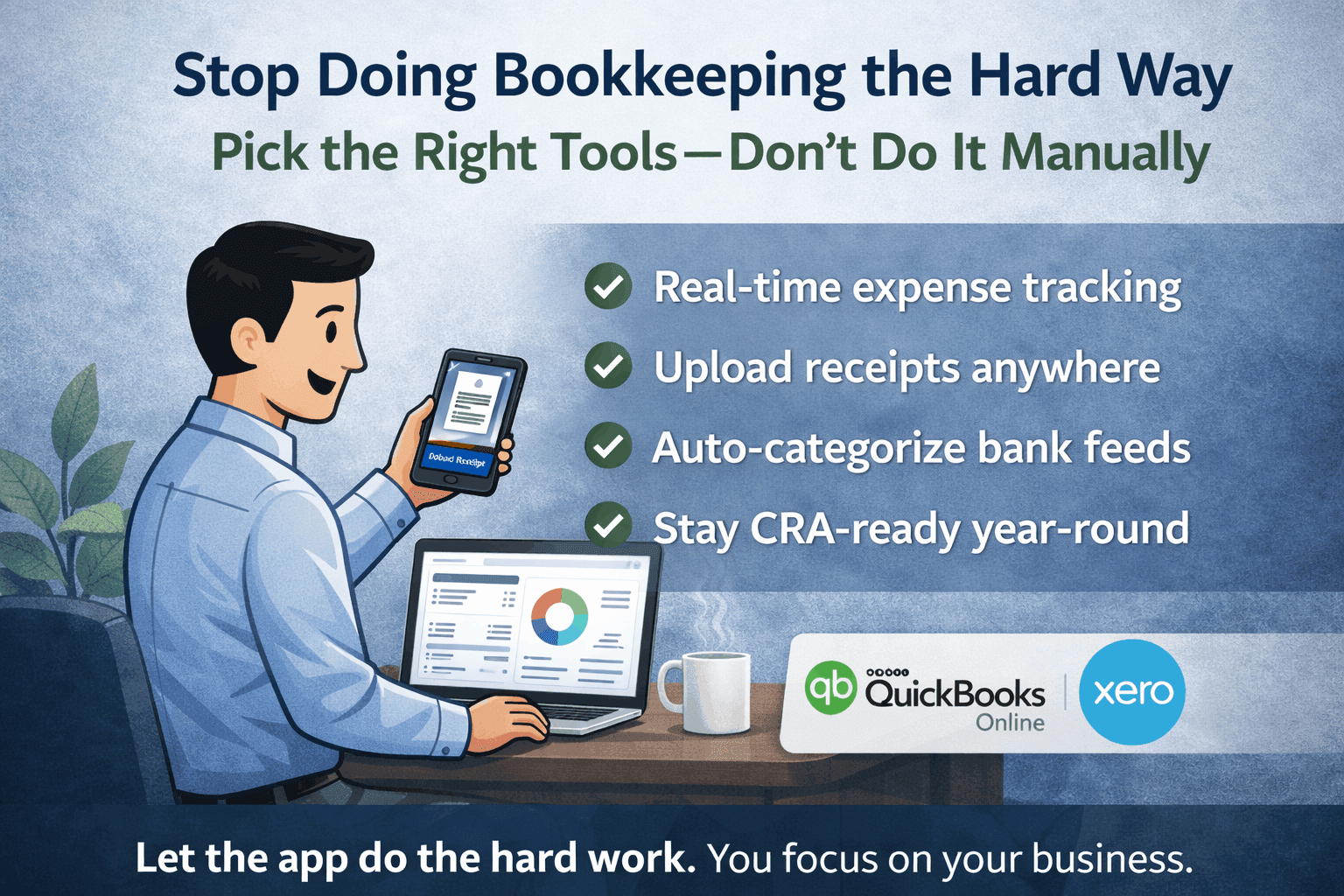
For most Canadian small businesses, the best bookkeeping software is QuickBooks Online or Xero, supported by three specialist tools: Dext or Hubdoc for receipt capture, Wagepoint for payroll, and A2X if you sell on Shopify or Amazon. QuickBooks Online starts at about $24 per month and Xero at $25 per month, and a complete automated stack typically lands between $50 and $150 per month. That is a fraction of the cleanup bill that follows a year of spreadsheets and shoebox receipts.
Why shouldn't you do your bookkeeping manually?
Spreadsheets feel free, but they cost you in three ways. First, missed deductions: lose one $50 receipt a week and you have thrown away roughly $2,600 in deductible expenses over a year. Second, backlog: books that get updated "later" get updated in April, under pressure, from memory. Third, cleanup fees: an accountant reconstructing twelve months of transactions charges far more than one keeping tidy books all year.
The CRA does not expect perfection, but it does expect complete, organized records, and it requires you to keep them for six years from the end of the last tax year they relate to. Cloud software meets that standard automatically: bank transactions import themselves, receipts are photographed and stored, and every entry has a document behind it. We cover the full requirements in our guide to record-keeping rules for Canadian small business owners.
QuickBooks Online vs Xero: which is better for Canadian small businesses?
Honestly, both are excellent, and we run client files on each every day. The differences are in pricing structure, user limits and ecosystem, not in whether one can "do bookkeeping" better than the other. Prices below are Canadian list prices before tax at the time of writing; both companies adjust pricing regularly and run frequent new-subscriber promotions, so confirm on their Canadian pricing pages before you commit.
| Feature | QuickBooks Online | Xero |
|---|---|---|
| Entry plan | EasyStart, from about $24/month | Starter, $25/month |
| Mid tier | Essentials, around $54/month | Standard, $60/month |
| Top tier | Plus and Advanced (prices change often) | Premium, $80/month |
| Users | Capped by plan: 1 on EasyStart, up to 3 on Essentials, 5 on Plus, 25 on Advanced | Unlimited users on every plan |
| Receipt capture | Built into the mobile app | Hubdoc included with every subscription |
| Multi-currency | Essentials plan and up | Premium plan only |
| Payroll | Paid add-on inside QuickBooks | No built-in Canadian payroll; pair it with Wagepoint |
| Entry-plan limits | Full ledger, single user | Roughly 20 invoices and 5 bills per month |
When QuickBooks Online is the better pick
- You want payroll, receipt capture and bookkeeping under one login and one bill.
- You already work with a bookkeeper; most Canadian bookkeepers know QBO inside out.
- You need multi-currency without paying for the top tier.
When Xero is the better pick
- Several people need access: unlimited users on every plan means no per-seat surprises.
- You want receipt capture bundled in, since Hubdoc comes with every subscription.
- You prefer Xero's cleaner bank reconciliation screen (a genuine strength, and the reason many accountants favour it).
What should you use for receipt capture?
The CRA accepts electronic images of receipts as long as they are complete and readable, so there is no reason to keep paper. The question is which capture tool feeds your ledger.
Hubdoc is the default answer for Xero users because it is included free with every Xero plan. Snap a photo, forward an email invoice, and it extracts the supplier, date, amount and tax, then pushes the transaction into Xero with the document attached.
Dext is the upgrade. Canadian plans start around $24 per month, it works with both QuickBooks Online and Xero, and its extraction accuracy and supplier rules are noticeably stronger, which matters once you process 50 or more documents a month. Rules like "every Petro-Canada receipt goes to fuel, 13 per cent HST, paid from the business Visa" mean most receipts post themselves.
If you are on QuickBooks Online with light volume, the built-in receipt snap in the QBO mobile app may be all you need to start.
How do Shopify and Amazon sellers keep their books accurate?
E-commerce is where manual bookkeeping truly breaks. The deposit that lands in your bank account is not your revenue: it is sales, minus refunds, minus platform fees, minus advertising, plus gift card movements, netted across a settlement period. Book deposits as sales and you understate both revenue and expenses, and your GST/HST return is wrong from line one.
A2X fixes this. It reads each Shopify or Amazon payout, splits it into its real components, posts one clean summary entry to QuickBooks Online or Xero, and matches it to the bank deposit so reconciliation closes to the penny. Plans start at about $29 USD per month and scale with order volume. For a seller doing a few hundred orders a month, it replaces hours of manual settlement math. We walk through the full setup in our guide to GST/HST for Shopify and Amazon sellers.
Remember the registration trigger: once your taxable sales pass $30,000 in a single calendar quarter or over four consecutive calendar quarters, you must register for GST/HST. Marketplace sellers hit that faster than they expect, and clean books are what tell you it happened. Our e-commerce accounting service builds this entire stack for sellers, including the sales tax mapping.
What should Canadian small businesses use for payroll?
Never run payroll in a spreadsheet. Source deductions have hard CRA remittance deadlines, and late remittances attract penalties. Wagepoint is built specifically for Canadian payroll: it calculates CPP, EI and income tax, remits your source deductions to the CRA on your behalf, files T4s and T4As at year end, and submits ROEs when someone leaves, all included in the price.
At the time of writing, the Solo plan is $20 per month plus $4 per employee for one pay run a month, and the Unlimited plan is $40 per month plus $6 per employee for unlimited pay runs. A two-person shop pays under $35 a month to make payroll compliance someone else's problem. QuickBooks' own payroll add-on is a reasonable alternative if you want everything inside QBO.
What stack does SNF Accounting actually use with clients?
We are deliberately not loyal to one ledger. Our standard build is QuickBooks Online or Xero at the core, chosen per client: QBO when the client wants payroll and books in one system or already knows the software, Xero when multiple team members need access or the client is a fit for the bundled Hubdoc capture. Around the core we add Dext for clients with heavy receipt volume, Wagepoint for payroll, and A2X for every Shopify and Amazon seller we onboard.
The reason is simple economics. Our fixed monthly pricing starts at $199, and that model only works because automation does the repetitive posting while our CPAs spend their time reviewing, correcting and advising. The same economics work in your favour: software that costs $50 a month and saves five hours pays for itself several times over.
When do spreadsheets stop working?
A spreadsheet is genuinely fine for a brand-new side business with a handful of transactions. It stops being fine at clearly identifiable moments:
- You register for GST/HST and must track tax collected and input tax credits by filing period.
- You hire your first employee and take on remittance deadlines.
- You start selling on Shopify, Amazon or any marketplace that pays you in netted settlements.
- You pass roughly 50 to 100 transactions a month and reconciliation takes evenings instead of minutes.
- You incorporate, or you need financial statements for a lender.
If two or more of these apply, the switch is overdue. Moving mid-year is easier than moving in March with a filing deadline looming.
Frequently Asked Questions
What is the best bookkeeping software for a small business in Canada?
QuickBooks Online and Xero are the two serious options for Canadian small businesses, and either one is a sound choice. QuickBooks Online suits owners who want payroll, receipt capture and bookkeeping in one subscription. Xero suits teams, because every plan includes unlimited users and bundled Hubdoc receipt capture. The bigger win is not the brand you pick but pairing the ledger with automated receipt capture and, if you sell online, a settlement connector like A2X.
Is Xero cheaper than QuickBooks Online in Canada?
At the entry level they are nearly identical: Xero Starter is $25 per month and QuickBooks EasyStart is about $24 per month before tax. The real cost difference shows up as you grow. Xero never charges per user, while QuickBooks caps users by tier, so a five-person team can be cheaper on Xero. But Xero's Starter plan limits you to roughly 20 invoices and 5 bills a month, and multi-currency requires its $80 Premium plan. Compare against your actual volume, not the sticker price.
Do I need Dext if QuickBooks already captures receipts?
Not always. The built-in receipt snap in the QuickBooks mobile app is adequate for owners handling a modest number of documents. Dext earns its roughly $24 per month once volume climbs past about 50 documents a month, because its supplier rules auto-code recurring purchases and its extraction needs less manual correction. For businesses drowning in fuel, supplier and materials receipts, the hours saved outweigh the fee quickly. Xero users often skip Dext at first since Hubdoc is already included.
Can I just use a spreadsheet until I register for GST/HST?
You can, but it is risky, because the spreadsheet is exactly what fails to warn you that you crossed the line. Registration is mandatory once taxable sales exceed $30,000 in a single calendar quarter or across four consecutive calendar quarters, and you must start charging tax from your registration date. Businesses that track sales loosely often discover the crossing months late and owe GST/HST they never collected. Real-time software shows a running revenue total, so the threshold never surprises you.
Will the CRA accept digital copies of my receipts?
Yes. The CRA accepts electronic records, including scanned or photographed receipts, provided the images are complete, readable and produced when requested. Whatever the format, records must be kept for six years from the end of the last tax year they relate to. This is exactly what receipt-capture tools like Dext and Hubdoc are built for: each photo is stored in the cloud and attached to the matching transaction in your ledger, which is a far stronger audit position than a box of faded thermal paper.
Not sure which stack fits your business? Book a free 30-minute consultation and we will map it out with you: the right ledger, the right add-ons, and nothing you do not need. SNF Accounting's fixed pricing starts at $199 per month, software setup and cleanup included.