
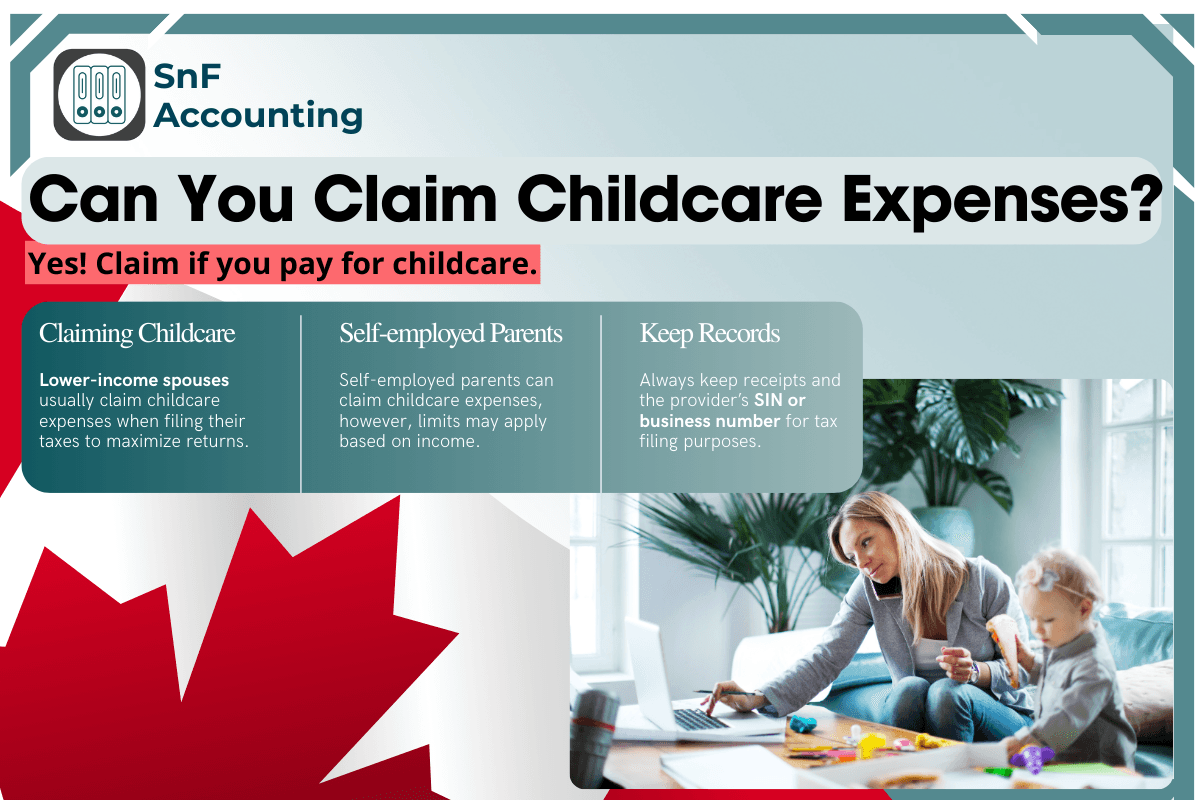
Yes. You can claim childcare expenses on your Canadian tax return even if you work from home. The CRA looks at why you paid for care, not where you did your job: as long as you paid someone to look after your child so you could earn employment income, run a business, or attend school, the deduction is available. For the 2025 tax year, the limits are up to $8,000 per child under 7, $5,000 per child aged 7 to 16, and $11,000 for a child who qualifies for the disability tax credit.
Does Working From Home Change Your Childcare Claim?
No. One of the most persistent tax myths in Canada is that childcare only counts if you commute to an office. The rules tie the deduction to earning income or attending school, not to where you sit while you earn it. A parent taking client calls from a home office in Etobicoke is treated exactly the same as one in a downtown tower.
What matters is the purpose of the care. If you paid a daycare so you could run your online store, meet clients over video, or finish a work shift from your kitchen table, those fees qualify. If you paid a babysitter so you could golf on a Saturday, they do not. The test is income-earning activity, and remote work passes it just as easily as in-person work.
One practical nuance: the CRA can question a claim where a parent was home all day and provided the care themselves. Being home is not the problem; not actually working is. Keep a record of your work schedule if your situation looks unusual, such as claiming full-time daycare while reporting very little income.
What Is Form T778 and How Does the Deduction Work?
Childcare expenses are claimed on line 21400 of your tax return, and Form T778, Child Care Expenses Deduction, is the worksheet where you calculate the amount. It is a deduction, not a credit, which means it reduces your taxable income dollar for dollar. The higher the claiming spouse's marginal tax rate, the more each receipt is worth.
Your allowable claim is the least of three amounts:
- The total eligible childcare expenses you actually paid in the year
- The combined annual limit for your children based on their ages
- Two-thirds of the claiming person's earned income for the year
That last cap surprises people. If the lower-income spouse earned $9,000 from part-time work, the household's childcare claim tops out at $6,000 for the year, even if daycare for a toddler cost $14,000.
How Much Can You Claim Per Child?
The annual limits, confirmed on the CRA's line 21400 guidance, are:
| Child's situation | Annual limit | Weekly limit (boarding school or overnight camp) |
|---|---|---|
| Under 7 at the end of the year | $8,000 | $200 |
| Aged 7 to 16 during the year | $5,000 | $125 |
| Eligible for the disability tax credit (any age) | $11,000 | $275 |
The limits stack per child. A family with a 4-year-old in full-time daycare and a 9-year-old in after-school care and summer day camps has a combined ceiling of $13,000. If the claiming spouse pays tax at a 30 per cent marginal rate, using the full amount returns roughly $3,900.
Note the separate weekly caps for overnight arrangements. A $2,000 two-week overnight camp for a 10-year-old is limited to $125 per week, so only $250 of it is claimable. Day camps, by contrast, are subject only to the annual limits.
Who Must Claim the Childcare Deduction?
In a couple, the spouse or common-law partner with the lower net income must make the claim. You cannot pick whichever return produces the bigger refund, and this rule catches families every year. Because the claim is also capped at two-thirds of the claiming person's earned income, a household where one spouse earned nothing generally gets no deduction at all for that year.
The higher-income spouse can claim for the weeks during which the lower-income spouse was:
- Enrolled in an eligible educational program at a secondary school, college, university, or other designated institution, lasting at least three consecutive weeks
- Incapable of caring for the children because of a mental or physical infirmity
- Confined to a prison or similar institution for at least two weeks in the year
- Living apart because of a relationship breakdown for at least 90 days
Separated parents who share custody can each claim the eligible expenses they personally paid, up to their share of the limits.
Which Providers and Expenses Qualify, and Which Do Not?
Eligible childcare
- Licensed daycare centres and day nursery schools
- Babysitters and nannies, including caregivers who come to your home
- Day camps and day sports schools where the primary purpose is childcare
- Before-school and after-school programs
- The childcare portion of boarding school or private school fees, within the weekly limits
Ineligible providers
You cannot claim amounts paid to the child's parent, to your spouse or common-law partner, to a person under 18 who is related to you, or to anyone you or another person claimed as a dependant on specific lines of the return. Paying your 16-year-old to watch their younger sibling produces no deduction. Paying an unrelated teenage babysitter, or a grandparent who is over 18 and not claimed as your dependant, can qualify if they give you a proper receipt and report the income.
Ineligible expenses
Medical expenses, clothing, transportation costs, and the tuition portion of a regular education program do not qualify. If a private school invoice bundles tuition and after-school care together, ask the school to break out the childcare portion, because only that part is claimable.
What If You Are Self-Employed and Working From Home?
Self-employed parents can absolutely claim childcare, and for many of them it is one of the larger deductions on the return. Your net self-employment income counts as earned income for the two-thirds cap, so a sole proprietor who nets $45,000 has room for up to $30,000 in claims before the per-child limits apply.
Two traps are worth flagging. First, childcare is a personal deduction on your T1, not a business expense. Do not run daycare fees through your business books, and do not deduct them against GST/HST. Second, if you are incorporated and pay yourself only dividends, you have a problem: dividends are not earned income for this purpose, so your childcare claim can collapse to zero. Owners who rely on this deduction often need at least some salary, which is the kind of planning decision we work through with clients on our fixed-fee monthly plans.
This comes up constantly with the home-based businesses we serve. An e-commerce seller packing Shopify orders in the garage while a toddler is at daycare is earning income in exactly the way the rules contemplate. The same logic covers realtors doing paperwork at home, Turo hosts managing bookings, and freelancers of every kind. Pair the childcare claim with the rest of the CRA-approved deductions available to small business owners and the savings compound quickly.
What Records Does the CRA Expect?
You do not file receipts with your return, but you must keep them, because line 21400 is one of the deductions the CRA reviews most often. A valid receipt shows the provider's name, the amount, the period of care, and the child's name. When the provider is an individual rather than an organization, the receipt must also show their social insurance number. No SIN on the receipt is one of the most common reasons a claim gets denied on review.
Keep everything for six years after the end of the tax year, the same standard that applies to business records. If your filing systems need work, our guide to record-keeping rules for Canadian small business owners covers what to keep and for how long.
Frequently Asked Questions
Can I claim childcare expenses if I work from home full time?
Yes. The deduction depends on why you paid for care, not where you worked. If you paid a daycare, babysitter, nanny, or day camp so you could earn employment income, run a business, or attend an eligible school program, the expenses qualify even if you never left the house. The usual rules still apply: the lower-income spouse generally claims, the per-child annual limits cap the amount, and you need receipts that include an individual provider's SIN.
How much can I claim per child in 2025?
Up to $8,000 for each child under 7 at the end of the year, $5,000 for each child aged 7 to 16, and $11,000 for a child of any age who is eligible for the disability tax credit. The total is further capped at two-thirds of the claiming person's earned income, and overnight camps and boarding schools carry weekly limits of $200, $125, and $275 respectively. Actual expenses paid are always the starting point.
Can the higher-income spouse ever claim childcare expenses?
Only in specific situations, and only for the weeks they apply. The higher-income spouse can claim while the lower-income spouse was enrolled in an eligible educational program of at least three consecutive weeks, was incapable of caring for the children due to infirmity, was confined to a prison or similar institution for at least two weeks, or was living separately due to a relationship breakdown for at least 90 days. Form T778 calculates a weekly amount for those periods.
Can I pay a family member to babysit and claim it?
It depends on who they are. Payments to the child's parent, to your spouse or common-law partner, to a related person under 18, or to someone claimed as a dependant are never deductible. A grandparent or adult relative who is 18 or older and not claimed as anyone's dependant can qualify, provided they give you a receipt with their SIN and report the income on their own return. Paying your own teenager does not work.
Are summer camps tax deductible in Canada?
Day camps and day sports schools qualify when their primary purpose is looking after children, and they are limited only by the annual per-child amounts. Overnight camps and boarding schools qualify too, but a weekly cap applies: $200 per week for a child under 7, $125 for a child aged 7 to 16, and $275 for a child eligible for the disability tax credit. Keep the camp's receipts, and note that purely recreational lesson fees may be challenged.
Childcare is often a family's single biggest claimable expense, and getting the T778 details right, from who claims to what the receipts must show, is worth real money. SNF Accounting is a CPA-led firm serving all of Canada with fixed pricing from $199 per month. Book a free 30-minute consultation and we will make sure this deduction, and every other one you are entitled to, lands on the right return.