
Yes, you must report side hustle income to the CRA, and there is no minimum: every dollar you earn from Turo rentals, Uber driving, Etsy sales or freelance work is taxable from the first dollar. Since January 1, 2024, digital platforms have also been legally required to report their sellers' earnings directly to the CRA, so in many cases the agency already knows what you made. This guide covers what to report, what you can deduct against it, when GST/HST kicks in, and how to fix past years before the CRA contacts you first.
Is side hustle income really taxable from the first dollar?
It is. Canada has no "casual income" exemption. Money earned with a profit motive is business income whether it arrives by e-transfer, PayPal, platform payout or cash, and whether it is $400 a year or $40,000. You report it on Form T2125, Statement of Business or Professional Activities, filed with your personal T1 return.
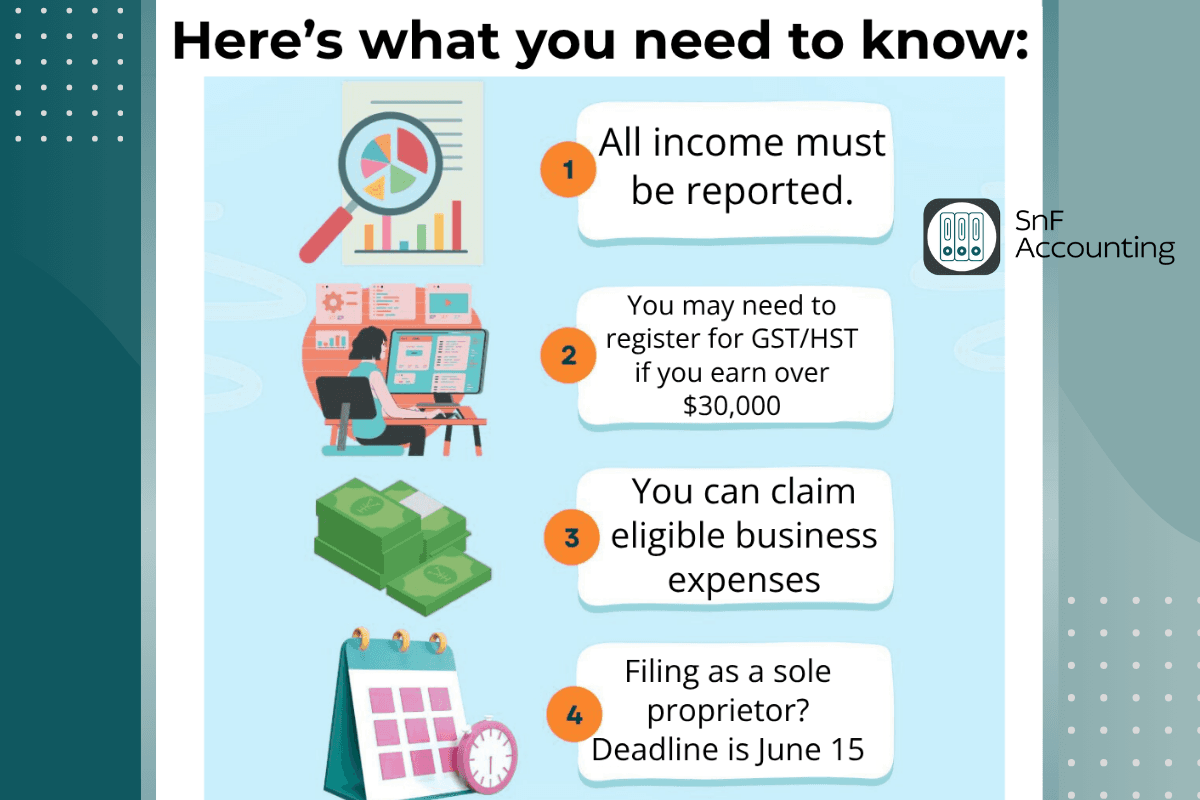
The $30,000 figure people often quote is the GST/HST registration threshold, not an income tax exemption. Income tax applies from dollar one; the $30,000 mark only determines when you must start charging sales tax.
Self-employment income also triggers CPP: you pay both the employee and employer share of contributions on net self-employment earnings above the $3,500 basic exemption, which surprises many first-time filers. On deadlines, self-employed Canadians have until June 15 to file, but any balance owing is still due April 30, so interest can start accruing even when your return is not late.
How does the CRA know about your side hustle?
Because platforms now tell them. Under the Reporting Rules for Digital Platform Operators, in force since January 1, 2024, platforms that facilitate sales of goods, personal services, rentals of real property or rentals of a means of transport must collect, verify and report seller information to the CRA. The first returns, covering 2024 activity, were due January 31, 2025, and platforms now file every year by January 31.
For each reportable seller, the platform sends the CRA your name, address, date of birth, tax identification number, the gross payments credited to you, and the fees, commissions and taxes it withheld. The CRA matches that data against what you filed.
There is one narrow carve-out: a goods seller with fewer than 30 sales totalling $2,800 or less in the year is an "excluded seller" the platform does not have to report. That covers someone clearing out a closet on a marketplace, but it applies only to goods. Services, ride-sharing and vehicle rentals have no minimum, so a Turo host who rented out a car for even a handful of trips should assume that income was reported.
Platform data is not the CRA's only source either: T4A slips, payment processor records and bank deposits reviewed during audits all feed the same matching machine.
How does the CRA treat common side hustles?
| Side hustle | How it is taxed | Does the platform report you? |
|---|---|---|
| Renting your car on Turo | Business income on T2125, with CCA available on the vehicle | Yes. Rental of a means of transport is reportable with no minimum |
| Driving for Uber or Lyft | Business income, plus mandatory GST/HST registration from the first dollar | Yes |
| Selling on Etsy, Amazon or eBay | Business income once you sell with a profit motive | Yes, unless you had fewer than 30 sales totalling $2,800 or less |
| Freelancing through Upwork or Fiverr | Business or professional income on T2125 | Yes. Personal services are reportable |
| Direct clients, no platform | Business income, same rules | No platform report, but invoices and deposits are still traceable |
For a deeper dive on the first row, see our guide to how Turo hosts are taxed in Canada.
What expenses can you claim against side hustle income?
You pay tax on net profit, not gross payouts, so tracking expenses is where most side hustlers leave money on the table. Reasonable costs incurred to earn the income are deductible, including:
- Platform fees and commissions (Turo's host fee, Etsy transaction fees, Uber's service fee)
- Vehicle costs for the business-use portion: insurance, maintenance, cleaning, parking
- Capital cost allowance (depreciation) on equipment or a rental vehicle
- Supplies, materials, packaging and shipping
- A home office portion of rent, utilities and internet where you qualify
- Business phone and software costs, advertising, and accounting fees
A quick example: a Turo host grosses $15,000 in a year. Turo keeps $3,750 in host fees, commercial-use insurance costs $1,600, and cleaning plus maintenance run $1,400. Before even touching capital cost allowance, taxable profit is $8,250, not $15,000. At a 30% marginal rate, claiming those documented expenses saves roughly $2,000 in tax. How you depreciate the vehicle matters too; see our guide to CCA vehicle classes for rental fleets.
Keep every receipt. The CRA generally requires you to keep business records for six years, and unsupported expenses are the first thing denied in a review.
When does a side hustle have to register for GST/HST?
Once your worldwide taxable sales exceed $30,000 over four consecutive calendar quarters, or in a single quarter, you stop being a small supplier and must register for GST/HST, then charge and remit it on your sales.
There is one major exception: commercial ride-sharing. Uber and Lyft drivers must register for GST/HST from their first dollar of fares, a rule in place since July 1, 2017. The $30,000 threshold does not protect them.
Turo hosts sit on the other side of that line: renting out your car is a vehicle rental, not ride-sharing, so the normal $30,000 threshold applies. Just do not assume the platform is handling sales tax for you; confirm what it collects and remits versus what remains your responsibility once you register. E-commerce sellers face their own wrinkles with marketplace rules, which we cover in GST/HST for Shopify and Amazon sellers.
What happens if you do not report side hustle income?
The cost scales up quickly:
- Repeated failure to report income. If you leave $500 or more off your return and did the same in any of the three previous years, the penalty is the lesser of 10% of the unreported amount and 50% of the understated tax, net of any tax withheld. Miss $8,000 of Turo income one year after missing $2,000 of Etsy income two years earlier, and you could face a penalty of up to $800 on top of the tax itself.
- Gross negligence. Where the CRA concludes you knowingly omitted income, the penalty is the greater of $100 and 50% of the understated tax.
- Late filing. Filing late with a balance owing costs 5% of the balance plus 1% per full month, up to 12 months. Repeat late filers can face 10% plus 2% per month for up to 20 months.
- Interest. Arrears interest compounds daily at the CRA's prescribed rate on top of everything above.
Can you fix past years before the CRA finds you?
Yes, and the window for doing it cheaply is while the CRA has not yet contacted you. The Voluntary Disclosures Program was overhauled effective October 1, 2025, and the current rules are notably more generous:
- Unprompted applications, filed before any CRA communication about the issue, qualify for 100% penalty relief and 75% interest relief.
- Prompted applications, filed after a CRA education letter or similar nudge, can still receive up to 100% penalty relief but only 25% interest relief.
You apply using Form RC199 with supporting documentation. Once an audit or investigation into the issue begins, the door closes entirely, so a Turo host with three unreported years is far better off disclosing now than waiting for a letter generated from platform data.
Frequently Asked Questions
Do I have to report side hustle income if it is under $30,000?
Yes. The $30,000 threshold only relates to GST/HST registration. For income tax there is no minimum: every dollar of net side hustle income must be reported on your T1 return, usually on Form T2125. Whether you earned $500 from a few Turo bookings or $25,000 from steady freelance work, it is taxable business income, and leaving it off in more than one year can trigger the repeated failure to report penalty.
Does Turo, Uber or Etsy report my income to the CRA?
Yes. Since January 1, 2024, digital platform operators must report seller identification details and gross earnings to the CRA each year, with returns due January 31 for the previous calendar year. Vehicle rentals, ride-sharing and services are reported with no minimum. The only carve-out is for goods sellers with fewer than 30 sales totalling $2,800 or less in a year. Assume the CRA can see your platform payouts, because in most cases it can.
What form do I use to report side hustle income?
Form T2125, Statement of Business or Professional Activities, filed as part of your personal T1 return. It captures gross income, expenses by category and capital cost allowance, arriving at the net business income that gets taxed. You file a separate T2125 for each distinct business activity. Self-employed filers have until June 15 to file, but any balance owing is still due April 30, so estimate and pay early to avoid interest.
Can I claim expenses if my side hustle barely made money?
Yes. You deduct reasonable expenses incurred to earn the income even if the result is a small profit or a loss, and a genuine business loss can generally be applied against your other income, such as employment earnings. The caveat is that the activity must be carried on with a reasonable expectation of profit. If the CRA views it as a hobby, losses will be denied, so keep records showing you operate in a businesslike way.
I have several unreported years. What should I do first?
Act before the CRA contacts you. Gather your platform statements and bank records, work out the unreported income and expenses for each year, and file through the Voluntary Disclosures Program using Form RC199. An unprompted application qualifies for full penalty relief and 75% interest relief under the rules in effect since October 1, 2025. A CPA can rebuild the numbers from platform data and handle the disclosure so it is complete the first time.
If your side hustle has outgrown the shoebox of receipts, SNF Accounting can take the whole thing off your plate, from T2125 filings and GST/HST registration to specialised accounting for car rental businesses and Turo hosts. Our fixed pricing starts at $199 per month, so you know the cost before we start. Book a free 30-minute consultation and we will tell you exactly where you stand with the CRA.